A cooling tower does not take care of itself. Water evaporates, minerals stay behind, dirt blows in, and the basin collects whatever settles. If nobody walks the tower and checks the basics, you usually find out the hard way: higher chiller head pressure, a noisy fan, a plugged strainer, or a bacteria result you did not want.
This cooling tower maintenance checklist is a practical starting point for facility managers. It is organized the way most manufacturer manuals are organized: daily, weekly, monthly, quarterly and annual. It is not a substitute for your tower's operation and maintenance manual, or for a written water management plan. Use those documents to set the exact tasks and intervals for your equipment.
A good program has two halves that have to work together. Cooling tower water treatment controls scale, corrosion and bacteria in the circulating water. Mechanical checks and cooling tower cleaning keep the equipment itself in shape. One does not replace the other.
Daily checks
These are short walk-around checks, usually done by the person on site. Manufacturer manuals commonly list them as daily items. Before anyone reaches into the unit, lock out the fan and the pumps.
- Look and listen for unusual noise or vibration at the fan, motor and drive.
- Check the water level in the cold-water basin, and that the makeup valve is working.
- Glance at the controller, if you have one: conductivity, blowdown (bleed), chemical feed, and any alarms.
- If the tower has a gearbox, check the operating oil level in the sight glass.
- Note anything obvious: leaks, overflow, dry spots on the fill, foam, or water that looks or smells off.
If you feed an oxidizing biocide, public-health guidance is to keep a measurable residual in the water throughout each day. That is usually done with automated feed and monitoring, not with a once-a-week pump.
Weekly checks
Manufacturer guidance and public-health guides both treat a weekly look as a baseline during the operating season.
- Walk the tower. Look for dirt, scale, algae, slime, or a musty smell.
- Check strainers and suction screens, and clean them if they are starting to clog.
- Confirm blowdown is occurring and that chemical tanks, feed pumps and injection points are working.
- If the system has low-flow piping, dead legs, or equalizer lines between cells, flush them. The CDC recommends flushing those at least weekly.
- Write down what you saw and what you corrected.
Monthly checks
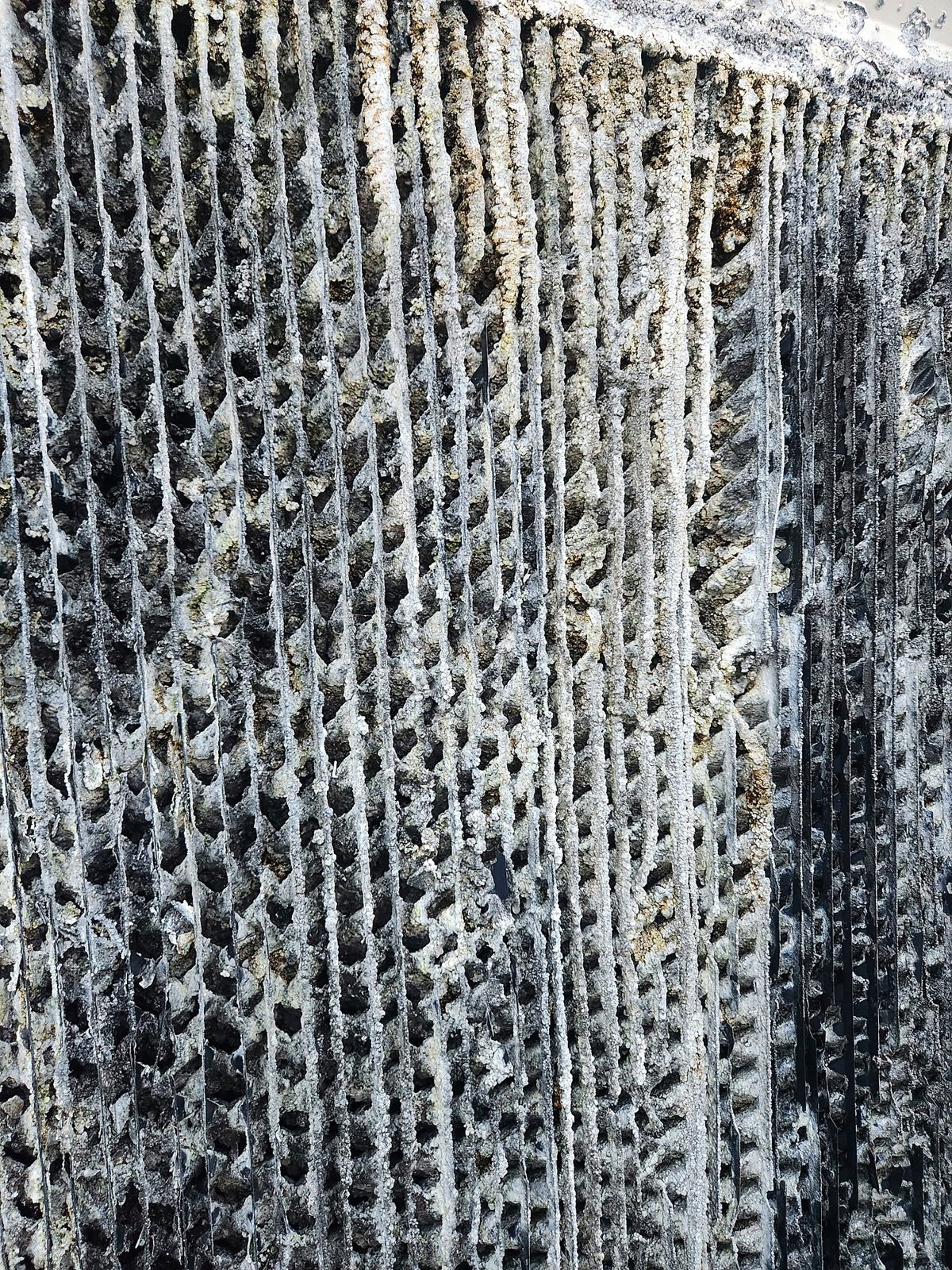
- Inspect the cold-water basin for sludge, scale or debris. A thin film of dirt is common. A layer of sludge you can scoop is a sign the basin needs to be cleaned.
- Look at the distribution system and nozzles. Dry sections of fill, or water spilling over the distribution deck, often mean plugged nozzles.
- Inspect accessible fill, drift eliminators and louvers for fouling, gaps or damage.
- Review the latest water-treatment tests and controller setpoints with the service report. Hydrovida checks residuals, conductivity and the controller on every visit and leaves a written report.
- Follow the manufacturer's monthly mechanical items, such as belt condition, oil condition, or a closer look at the fan and drive.
Quarterly checks
- Do the deeper mechanical items in the manufacturer's manual. On many towers that includes belt tension, bearing lubrication, and a closer look at the fan, motor and drive. Intervals vary, and some items are tied to running hours, so follow the manual for your model.
- Review several months of treatment results, makeup and blowdown, and any bacteria or Legionella tests, and close out open items.
- For hospitals and other higher-risk sites, Legionella testing is often done on a quarterly schedule set in the water management plan. That frequency is not universal. See our Legionella risk page for how a plan, testing and records fit together.
Annual checks, and seasonal startup or shutdown
Public-health guidance and manufacturer manuals do not all use the same cleaning interval. The right frequency depends on load, location and how dirty the tower gets.
- The CDC recommends taking a cooling tower out of service for cleaning and disinfection at least once a year, and more often based on how the tower operates. It also says to follow the manufacturer for cleaning before startup, when the tower is idling, and after shutdown.
- OSHA recommends cleaning and disinfecting at least twice a year, often before a seasonal start-up and after shutdown, and more often if the tower is heavily fouled or has had a high Legionella result.
- A typical manufacturer manual also calls for visual inspections at least weekly in season and periodic flushing and cleaning at least twice a year.
- Hydrovida's practice, as described on our cooling tower cleaning page, is a full cleaning and disinfection at least once a year, and twice a year in dusty or high-load areas.
A full cleaning is more than draining the basin. It includes a disinfection step before deposits are disturbed, removal of sludge and debris, cleaning of nozzles, fill, louvers and drift eliminators, an inspection of the structure, and a disinfection and restart with treatment set correctly. If fill has collapsed or the structure is rusting, cleaning will not be enough. That is a repair conversation.
At least once a year, also do the manufacturer's annual mechanical and safety inspection: structure, fasteners, fan, guards, ladders and walkways, and any oil change or coating work the manual calls for.
If you take the tower out of service for a stretch, do not leave untreated water sitting in the system. Follow the manufacturer's shutdown and startup steps, and disinfect before you return it to service.
Keep a record
A checklist only helps if someone writes down what was done. The CDC, OSHA and ASHRAE Standard 188 all expect a facility to keep operating and maintenance records on site: inspections, cleaning and disinfection dates, test results, and corrective actions. That paperwork is also what a surveyor or investigator will ask for.
Where a treatment program fits
Daily and weekly checks catch problems early. They do not replace a treatment program. Scale, corrosion and bacteria are controlled by the chemistry, the cycles of concentration, and the controller, checked on a regular service visit. Hydrovida service programs typically include monthly or weekly visits, depending on how critical the system is, with a written report every time. Cleaning, repairs and extra lab work are quoted separately.
Most testing is done on site. Difficult waters and Legionella testing are handled in Hydrovida's lab.
If you want a clear picture of where your tower stands, start with a free on-site water analysis. We'll walk the tower, test the water and tell you plainly what we find, with no cost and no obligation. Or call (866) 808-3315.